How to understand the counting rules of probability theory?
292 播放时长:264
加载播放器...
How to understand the counting rules of probability theory?
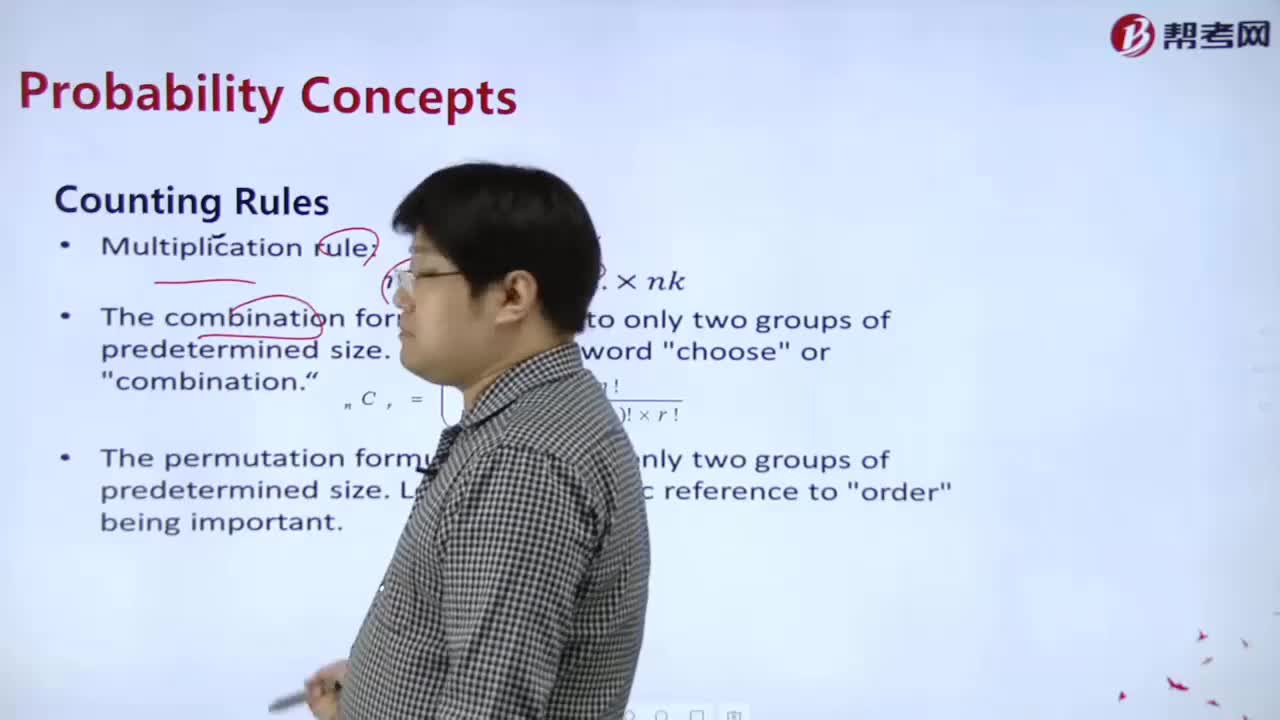
The counting rules of probability theory are used to determine the number of possible outcomes for an event. There are three main counting rules:
1. The multiplication rule: This rule states that if there are n ways to perform one task and m ways to perform another task, then there are n x m ways to perform both tasks together.
For example, if you have 3 shirts and 4 pants, then you have 3 x 4 = 12 possible outfits.
2. The addition rule: This rule states that if there are n ways to perform one task and m ways to perform another task, then there are n + m ways to perform either task.
For example, if you have 3 shirts and 4 pants, then you have 3 + 4 = 7 possible choices for what to wear.
3. The permutation rule: This rule states that if there are n objects and you want to choose r of them in a specific order, then there are nPr = n!/(n-r)! possible ways to do so.
For example, if you have 5 books and you want to choose 3 of them to read in a specific order, then there are 5P3 = 5!/(5-3)! = 60 possible ways to do so.
Understanding these counting rules is important in probability theory as they help to calculate the probability of an event occurring by determining the number of possible outcomes.
CFA考试视频CFA一级视频How to understand the counting rules of probability theory?