Natural Monopoly in a Regulated Pricing Environment
346 播放时长:184
加载播放器...
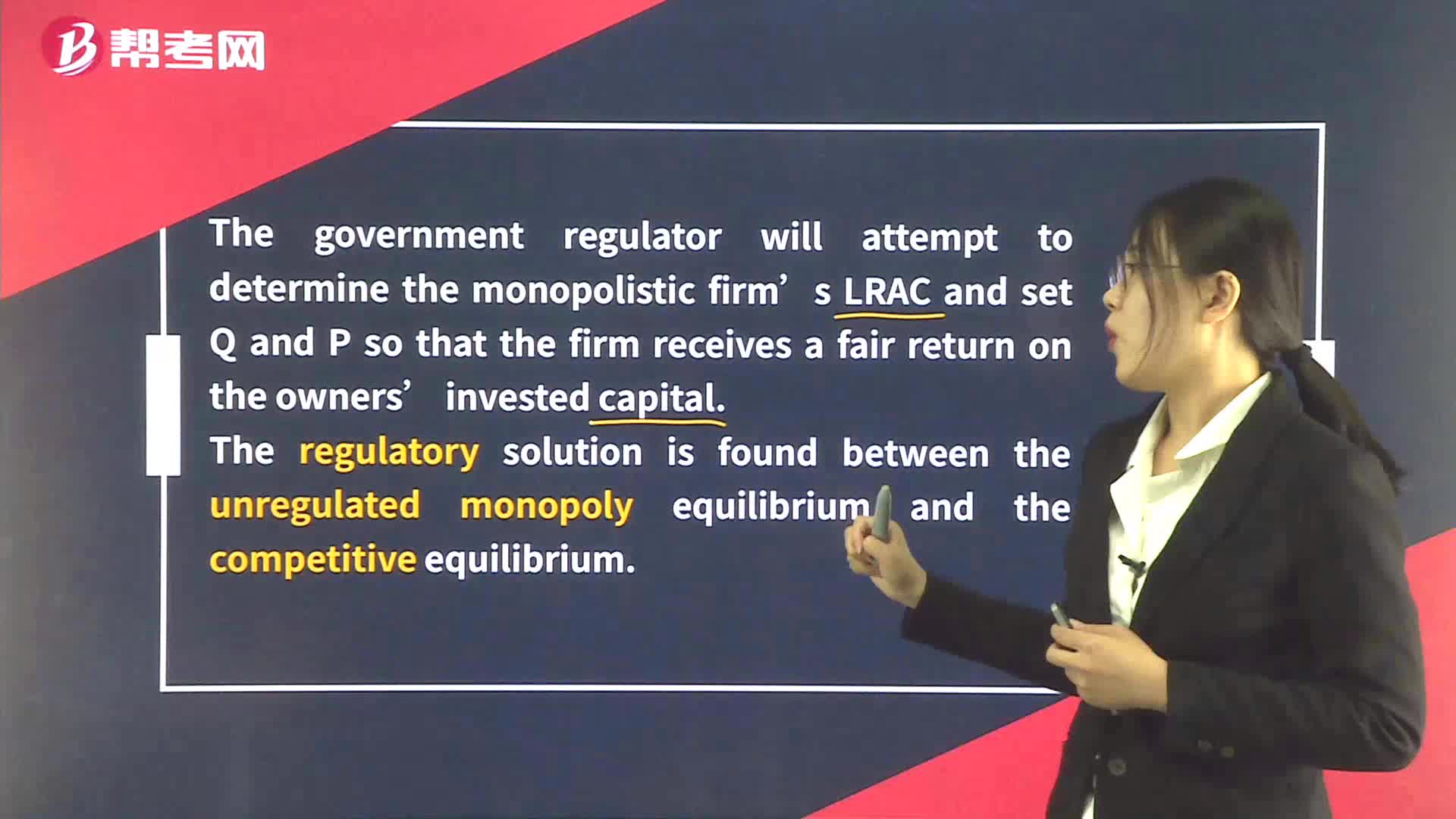
monopoly equilibrium and the competitive equilibrium.
A natural monopoly occurs when a single firm can produce and distribute a good or service at a lower cost than any potential competitor. This may be due to economies of scale, where the cost per unit of output decreases as the scale of production increases. In a regulated pricing environment, the government sets the price that the natural monopoly can charge for its product or service, usually through a regulatory agency.
Regulated pricing is intended to prevent the natural monopoly from charging excessively high prices due to their market power. However, setting the price too low can lead to underinvestment in the infrastructure needed to maintain the natural monopoly, which can lead to lower quality service or even service disruptions.
To balance these concerns, regulatory agencies may use a variety of pricing mechanisms, such as cost-plus pricing, where the regulated firm can charge a markup on its costs to cover a reasonable profit. Alternatively, the regulator may set a price ceiling or floor, which limits the maximum or minimum price that the natural monopoly can charge.
Regulatory agencies may also use performance-based regulation, where the regulated firm is incentivized to meet certain performance targets, such as reducing costs, improving service quality, or investing in new infrastructure. This can help to align the interests of the natural monopoly with those of consumers and ensure that the regulated firm is investing in the long-term sustainability of its infrastructure.
Overall, regulating the pricing of natural monopolies is a complex task that requires balancing the interests of consumers, the regulated firm, and the long-term sustainability of the infrastructure. A well-designed regulatory framework can help to ensure that consumers receive high-quality service at a fair price, while also incentivizing the natural monopoly to invest in its infrastructure and maintain its market power.
CFA考试视频Natural Monopoly in a Regulated Pricing EnvironmentCFA一级视频