The Lognormal Distribution
372 播放时长:219
加载播放器...
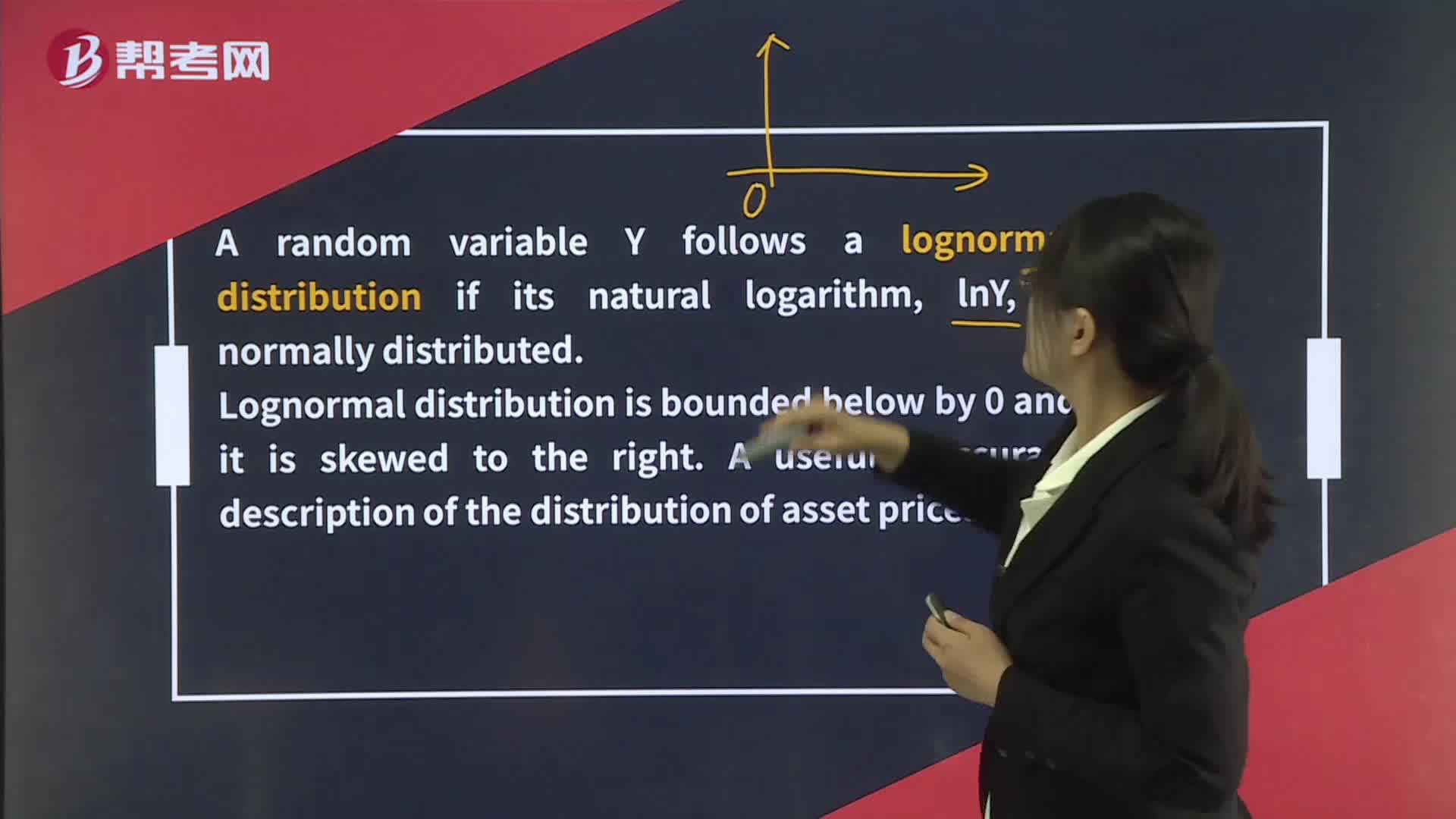
lnY:[PracticeBcannot have negative values.
The lognormal distribution is a probability distribution that is commonly used to model data that is positively skewed and has a wide range of values. It is a continuous distribution that is defined by two parameters: the mean (μ) and the standard deviation (σ) of the logarithm of the data.
The probability density function (PDF) of the lognormal distribution is:
f(x) = (1 / (xσ√(2π))) * e^(-(ln(x) - μ)^2 / (2σ^2))
where x > 0, μ is the mean of the logarithm of the data, and σ is the standard deviation of the logarithm of the data.
The cumulative distribution function (CDF) of the lognormal distribution is:
F(x) = Φ((ln(x) - μ) / σ)
where Φ is the standard normal cumulative distribution function.
The lognormal distribution has several important properties, including:
1. The mean and median of the distribution are not equal, and the median is typically smaller than the mean.
2. The distribution is skewed to the right, meaning that there are more values on the lower end of the distribution than on the higher end.
3. The distribution has a long tail, which means that there is a small but non-zero probability of observing very large values.
The lognormal distribution is commonly used in finance, economics, and biology to model data such as stock prices, income, and species abundance. It is also used in reliability engineering to model the failure times of components and systems.
CFA考试视频The Lognormal DistributionCFA一级视频


