Hypothesis Tests Concerning the Mean
354 播放时长:646
加载播放器...
μ,The:Independent samples:[PracticeB.C.the consultant’s
Hypothesis tests concerning the mean are statistical tests that are used to determine whether there is a significant difference between the mean of a sample and a known or assumed population mean. The null hypothesis in such tests is that the sample mean is equal to the population mean, while the alternative hypothesis is that the sample mean is either greater or less than the population mean.
There are two main types of hypothesis tests concerning the mean: one-sample tests and two-sample tests. One-sample tests are used to compare the mean of a single sample to a known or assumed population mean, while two-sample tests are used to compare the means of two independent samples.
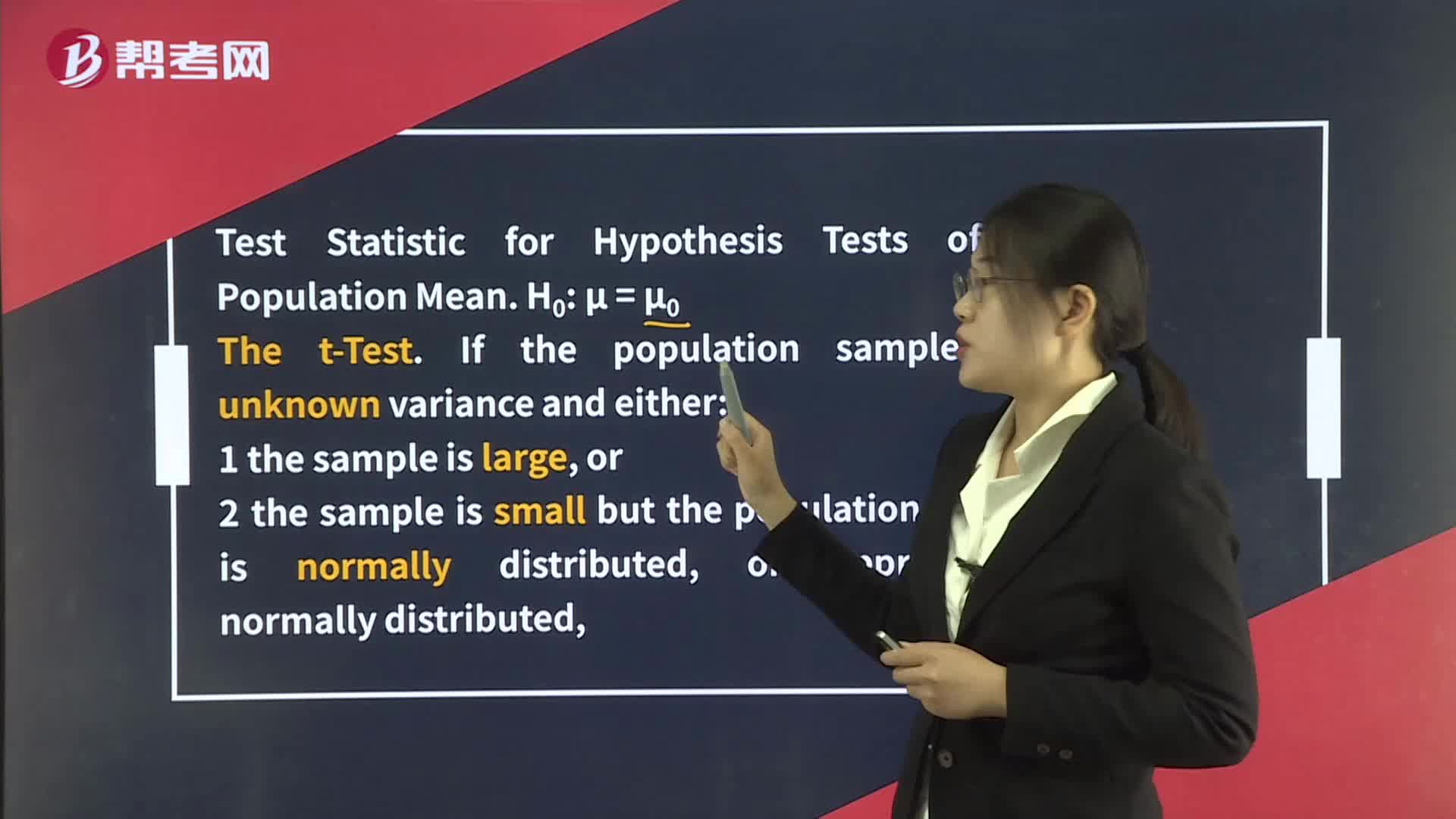
One-sample tests typically involve the use of a t-test, which is a statistical test that compares the mean of a sample to a known or assumed population mean. The t-test calculates a t-statistic, which is then compared to a critical value from the t-distribution to determine whether the null hypothesis can be rejected.
Two-sample tests, on the other hand, can involve the use of either a t-test or a z-test, depending on the characteristics of the samples being compared. A t-test is used when the sample sizes are small and the population variances are unknown, while a z-test is used when the sample sizes are large and the population variances are known or assumed to be equal.
In both one-sample and two-sample tests, the level of significance, or alpha, is set by the researcher prior to conducting the test. If the calculated p-value is less than the level of significance, the null hypothesis is rejected and it is concluded that there is a significant difference between the sample mean and the population mean. If the calculated p-value is greater than the level of significance, the null hypothesis cannot be rejected and it is concluded that there is not a significant difference between the sample mean and the population mean.
CFA考试视频Hypothesis Tests Concerning the MeanCFA一级视频


