Coefficient of Variation
238 播放时长:39

加载播放器...
Coefficient of Variation
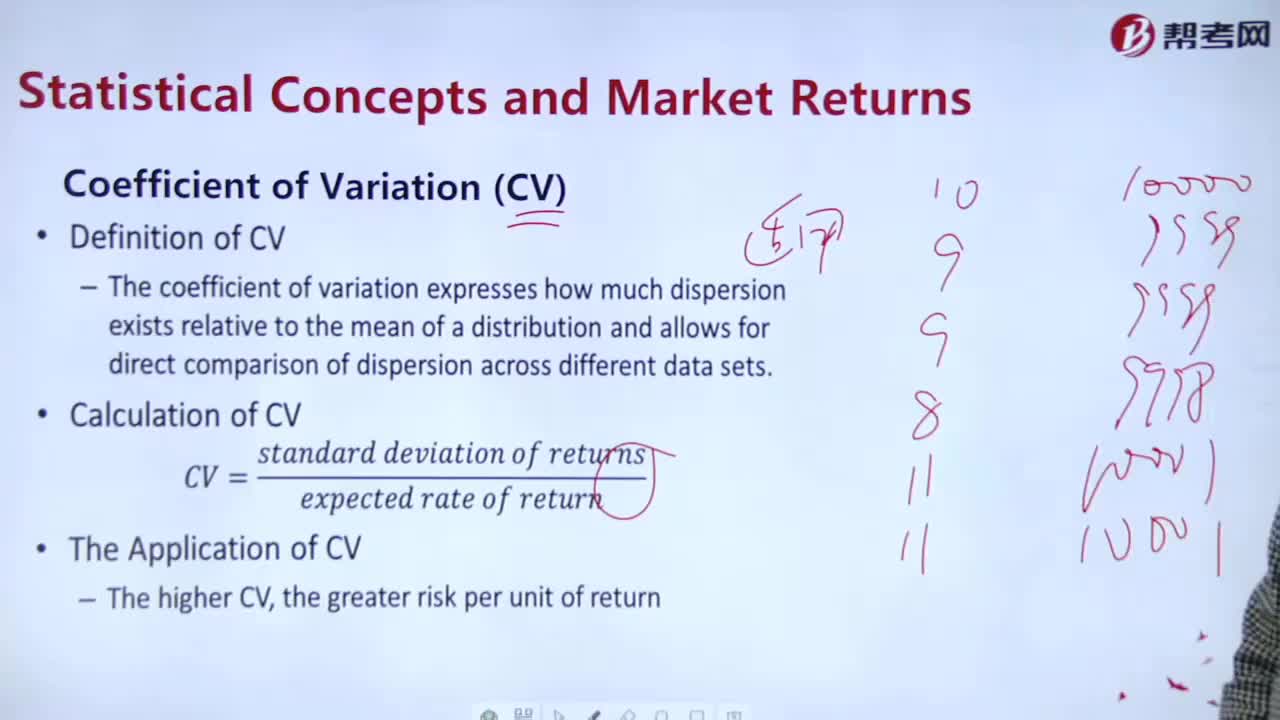
The coefficient of variation (CV) is a statistical measure that expresses the variability of a set of data relative to its mean. It is calculated as the ratio of the standard deviation to the mean, expressed as a percentage.
CV = (standard deviation / mean) x 100%
The coefficient of variation is a useful tool for comparing the variability of two or more sets of data that have different units of measurement or scales. It is commonly used in fields such as finance, economics, engineering, and biology to assess the reliability and consistency of data.
A low coefficient of variation indicates that the data points are closely clustered around the mean, while a high coefficient of variation indicates that the data points are more spread out. The coefficient of variation is often used in combination with other statistical measures, such as the mean and standard deviation, to provide a more complete picture of the data.
CFA考试视频Coefficient of VariationCFA一级视频