Expected Value & Variance
476 播放时长:464
加载播放器...
Expected Value Variance:million.,B.,C.,$32.40 million.,600.
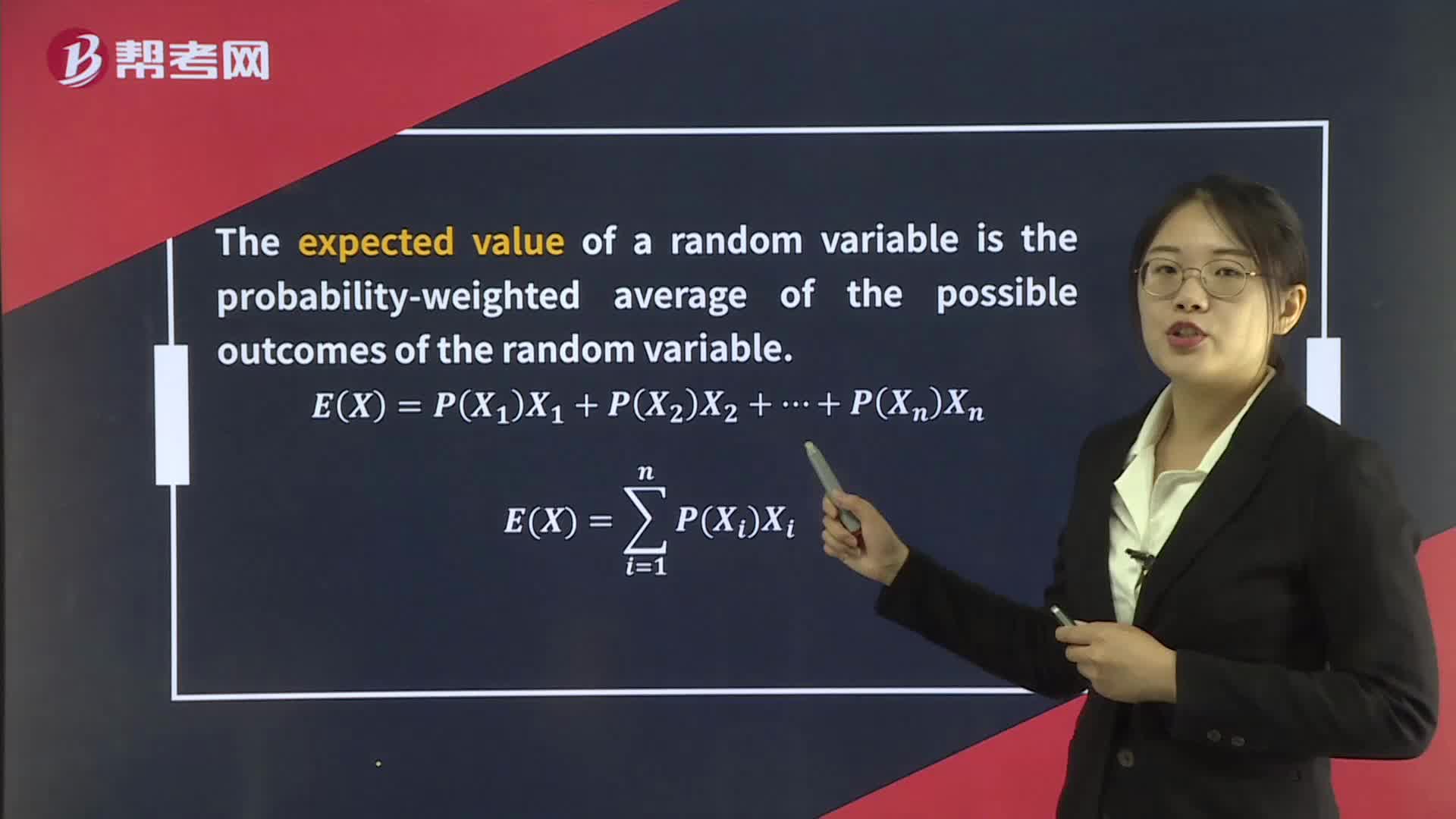
Expected value and variance are two important concepts in probability theory and statistics. The expected value is the average value of a random variable, while the variance measures how spread out the values of the random variable are.
Expected Value:
The expected value of a random variable is the sum of the products of each possible value of the variable and its corresponding probability. It is denoted by E(X) and is calculated as follows:
E(X) = ∑ x P(X = x)
where x is the possible value of the random variable X and P(X = x) is the probability of X taking the value x.
For example, consider a fair six-sided die. The possible values of the random variable X are 1, 2, 3, 4, 5, and 6, each with a probability of 1/6. The expected value of X is:
E(X) = (1 x 1/6) + (2 x 1/6) + (3 x 1/6) + (4 x 1/6) + (5 x 1/6) + (6 x 1/6) = 3.5
This means that if we roll the die many times, we can expect the average value to be close to 3.5.
Variance:
The variance of a random variable measures how much the values of the variable deviate from its expected value. It is denoted by Var(X) and is calculated as follows:
Var(X) = E[(X - E(X))^2]
where E(X) is the expected value of X.
For example, consider the same fair six-sided die. The expected value of X is 3.5. The variance of X is:
Var(X) = E[(X - E(X))^2] = [(1 - 3.5)^2 x 1/6] + [(2 - 3.5)^2 x 1/6] + [(3 - 3.5)^2 x 1/6] + [(4 - 3.5)^2 x 1/6] + [(5 - 3.5)^2 x 1/6] + [(6 - 3.5)^2 x 1/6] = 2.92
This means that the values of X are spread out around the expected value of 3.5, with an average deviation of about 1.71.
CFA考试视频Expected Value