Expected Value and Variance
389 播放时长:446
加载播放器...
A. $9.81:million.,0.05$70 – 37.752 + 0.70$40 – 37.752 + 0.25$25 – 37.752 = $96.18 million. The standard deviation is thus σ = $96.1812 = $9.81 million.,$63600.
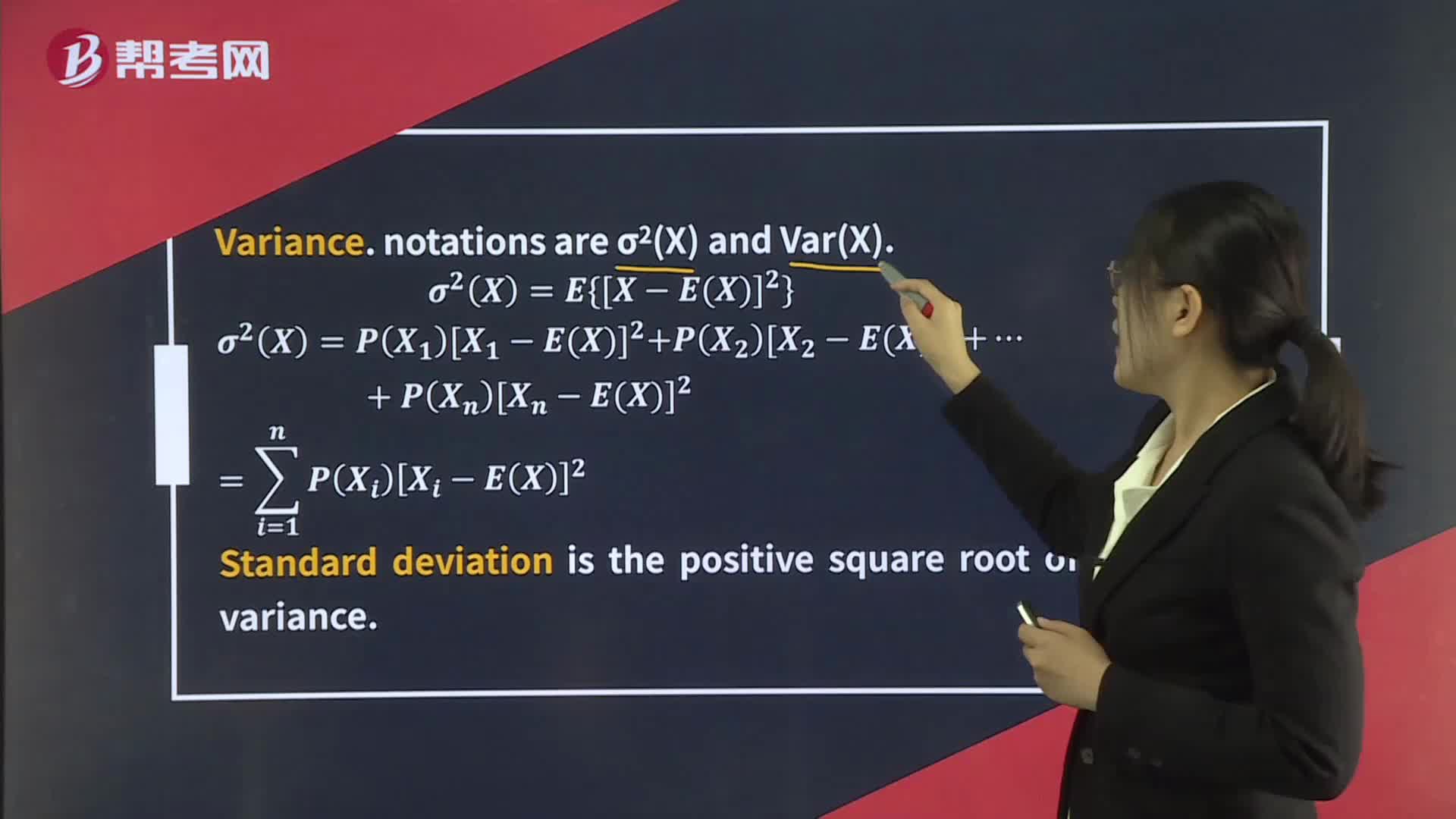
Expected value and variance are two important concepts in probability theory and statistics.
Expected value is the average value that we can expect to get from a random variable over a large number of trials. It is calculated by multiplying each possible outcome of the random variable by its probability and adding up the results. For example, if we roll a fair six-sided die, the expected value of the roll is (1/6) x 1 + (1/6) x 2 + (1/6) x 3 + (1/6) x 4 + (1/6) x 5 + (1/6) x 6 = 3.5.
Variance is a measure of how spread out a set of data is. It is calculated by taking the difference between each value and the expected value, squaring the result, multiplying it by the probability of that value, and adding up the results. For example, if we roll a fair six-sided die, the variance of the roll is [(1-3.5)^2 x 1/6] + [(2-3.5)^2 x 1/6] + [(3-3.5)^2 x 1/6] + [(4-3.5)^2 x 1/6] + [(5-3.5)^2 x 1/6] + [(6-3.5)^2 x 1/6] = 2.92.
In summary, expected value tells us what we can expect to get on average from a random variable, while variance tells us how spread out the possible outcomes are.
CFA考试视频Expected Value and VarianceCFA一级视频